
How to Read a Research Compound Certificate of Analysis
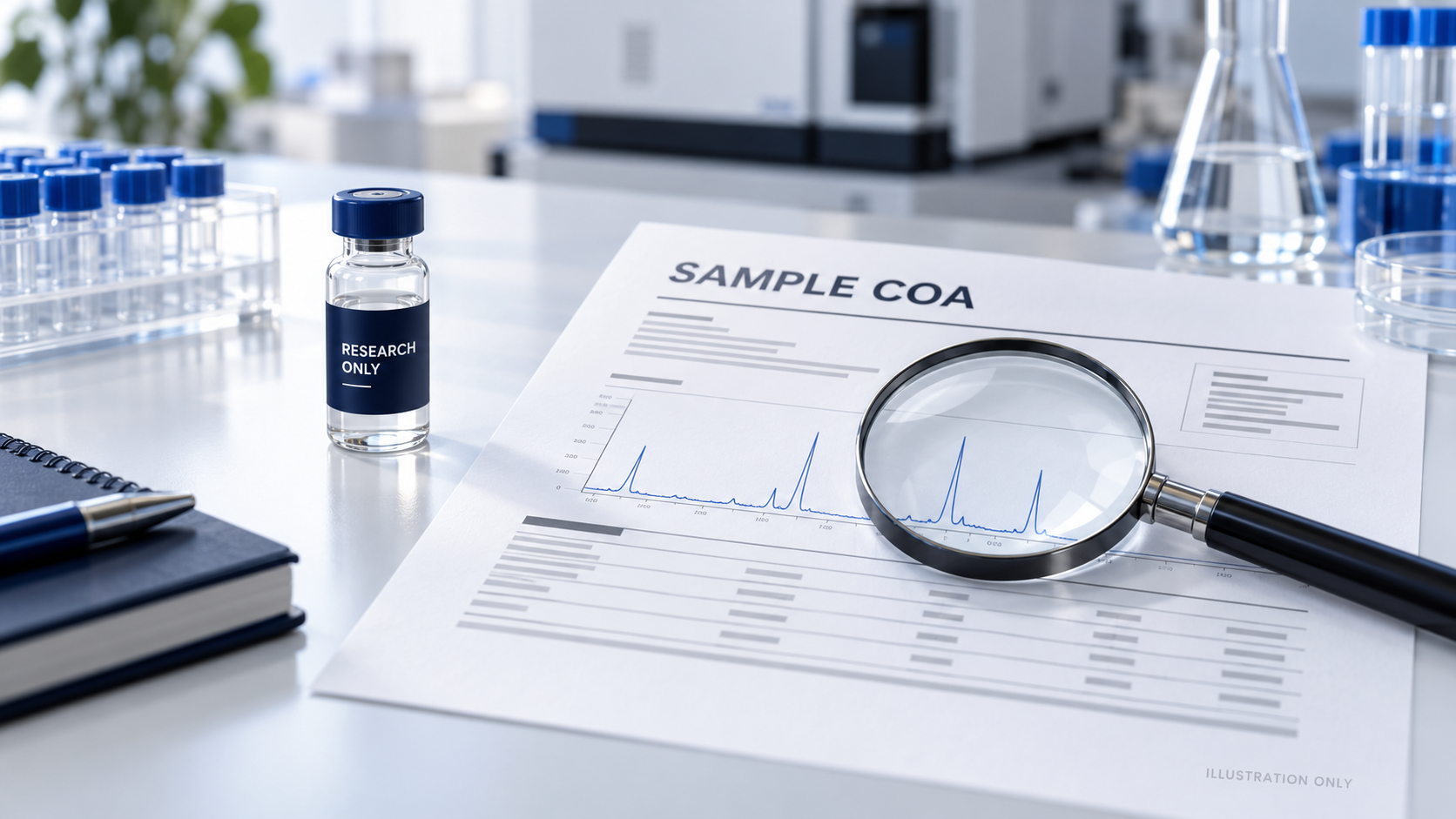
A Certificate of Analysis (COA) is a laboratory report describing the tests and results for an identified sample or batch. Learning how to read a Certificate of Analysis starts with matching the material to the report—not just looking for a high purity percentage.
This guide explains the fields to check when reviewing research compound documentation. It is an educational reference for laboratory records, not guidance on human or animal use.
What Does a COA Tell You?
A COA may report identity, chromatographic purity, measured quantity or other properties. Its scope depends on the tests performed. Not every certificate contains the same information, and a result applies to the identified sample under the stated analytical conditions.
A supplier’s COA is not automatically a certificate for a certified reference material. NIST describes certified reference materials in terms of specified property values, measurement uncertainty and metrological traceability. Do not assume those requirements have been met merely because a document is called a COA.
How to Read a Certificate of Analysis: Five Steps
1. Match the Product and Batch
Compare the compound name, formulation and batch or lot identifier with the vial label and order records. A certificate for a different production run does not document the batch you received. For a blend, check the named components rather than relying only on the blend’s marketing name.
Report numbers and batch numbers may be separate fields. If the vial and report use different identifiers, ask the supplier for documentation connecting them. Do not guess that two similar codes mean the same thing.
2. Identify the Laboratory and Verify the Report
Look for the testing laboratory, report identifier and a verification link or other contact route. Where verification is offered, compare the online record with the supplied document. A logo alone does not establish a report’s authenticity or a laboratory’s accreditation. Any accreditation claim should be checked for the relevant laboratory and testing scope.
3. Check the Dates and Sample Description
Note the sample receipt, test and report dates where supplied. These may differ. A testing date is not automatically a manufacturing date or an expiry date. Review the sample description and any stated storage conditions or validity period; request clarification when important information is missing.
4. Read the Method Alongside the Result
Read each result with its method, units and any acceptance criteria. A percentage, a mass in milligrams and an identity finding describe different properties. “Pass” is useful only when you can identify what was tested and what criterion was applied.
5. Record the Limitations
Check which properties are absent. A chromatographic purity result does not itself establish sterility, endotoxin levels, residual solvents or the absence of every contaminant. Those require relevant testing and reported results. Keep the certificate with your receiving records and retain the link between the vial, batch and document.
Purity Percentage Is Not Vial Quantity
Chromatographic area percentage describes a peak’s share of the integrated detector signal. Agilent’s documentation explains that its Area% calculation uses peak areas without response factors; interpretation depends on how components respond to the detector.
Illustrative example—not a V3 batch result: a vial labeled 10mg and a report showing 99% chromatographic purity do not, by themselves, demonstrate that the vial contains 9.9mg of the named compound. Establishing quantity needs an appropriate quantitative measurement. Look for a separately reported assay or content result, its units and its method.
A Practical Example from the V3 Research Library
At this article’s update, our Research Library lists a MOTS-C 40mg entry with the identifier COAC2609040028 and a displayed test date of September 6, 2026. Use these fields as starting points for checking documentation:
| Library field | What to check next |
|---|---|
| MOTS-C 40mg | Compare the compound and labeled quantity with the product and vial. |
| COAC2609040028 | Open the report and establish how this identifier connects to the vial’s batch code. |
| September 6, 2026 | Confirm the date and its meaning in the underlying report. |
This example explains how to navigate a library entry; it is not an independent validation of the laboratory findings or confirmation that the report matches every vial currently offered. Read the underlying report for methods and results. Certificates and available batches can change.
Questions to Ask When Information Is Missing
- Does this report match the batch on my vial?
- Is the identifier a report number, a batch number or both?
- Which test supports the stated identity or purity?
- Is quantity measured separately, or only stated on the label?
- Are there additional report pages or verification records?
If a matching certificate is not available, contact V3 Compounds with the product name and batch code. Do not substitute a different batch’s certificate.
Find Product Documentation
Use the COA Research Library to locate available documents, or review specifications on the research compound catalog and the KPV 10mg and BPC-157 10mg product pages. Each product page links to its available certificate; compare the report identifiers with the vial you receive.
Sources and Further Reading
- NIST: Reference material and certificate definitions—background on certified values, uncertainty and traceability; not a certification or endorsement of V3 products.
- Agilent OpenLab: Area% and height%—how chromatographic area percentages are calculated.
Prepared by V3 Compounds. Updated October 11, 2026. The library example reflects the information displayed on that date.