
HPLC Purity vs. Compound Quantity: What Is the Difference?
HPLC purity vs compound quantity compares two different measurements. A chromatographic percentage describes a result under a stated analytical method. A quantity such as 10mg describes an amount of material. Reading the two as interchangeable can lead to conclusions the report does not support.
This guide explains how to separate labeled vial quantity, chromatographic area percentage and measured content when reviewing research compound documentation. For the broader review process, begin with our Certificate of Analysis guide.
HPLC Purity vs Compound Quantity: Three Numbers That Should Stay Separate
A report may display several numbers close together even though they answer different questions. Keeping those fields separate is the first step toward an accurate reading.
| Field | Question it addresses | What to verify |
|---|---|---|
| Labeled vial quantity | What amount is the product described as containing? | Whether the number is nominal or supported by a separate measurement. |
| Chromatographic area percentage | What share of the integrated detector signal is attributed to a peak? | The detector, integration procedure and calculation method. |
| Measured content or assay | What amount or concentration was determined? | Units, calibration, sample preparation, reporting basis and uncertainty where available. |
What HPLC Area Percentage Measures
High-performance liquid chromatography separates components before a detector records a signal. Agilent describes Area% as a peak’s area divided by the total area of the peaks included in the calculation. Its Area% procedure uses no response factors.
That distinction matters because different components may produce different detector responses. An area percentage should therefore be interpreted with the laboratory’s stated method, detector and integration settings rather than treated as a universal mass fraction.
A Worked Example Without the Guesswork
Illustrative numbers only: imagine a product label says 10mg and the associated report lists 99% HPLC area purity. Those two fields alone do not establish a measured content of 9.9mg. The label may describe a nominal quantity, while the chromatographic figure describes relative detector response under the stated method.
If the report separately lists a quantitative result, read its units carefully. Milligrams per vial, milligrams per gram and milligrams per milliliter cannot be compared without understanding sample preparation and the reporting basis. A percentage assay may also have a different meaning from an area percentage.
What to Ask About a Quantity Result
- Was content actually measured, or is the amount copied from the product label?
- Does the reported result apply to the entire vial or to a prepared sample?
- What reference material or calibration procedure was used?
- What uncertainty, range or acceptance criterion accompanies the result?
- Is the result specific to the batch named in the report?
These are documentation questions to direct to the supplier or testing laboratory. They are not instructions for making, administering or personally using a compound.
Read “Pass” With Its Specification
A pass/fail statement is meaningful only when the report identifies the property tested and the acceptance criterion applied. A purity pass should not be expanded into a claim about every other property. Likewise, a content result does not independently establish identity, sterility, stability or suitability for a particular use.
Keep the Report With the Batch
Retain the original report rather than a cropped screenshot of one purity number. Keep the product name, batch identifier, method, units and report date together in laboratory records. If a certificate is missing or its units are unclear, request clarification instead of filling in the gaps.
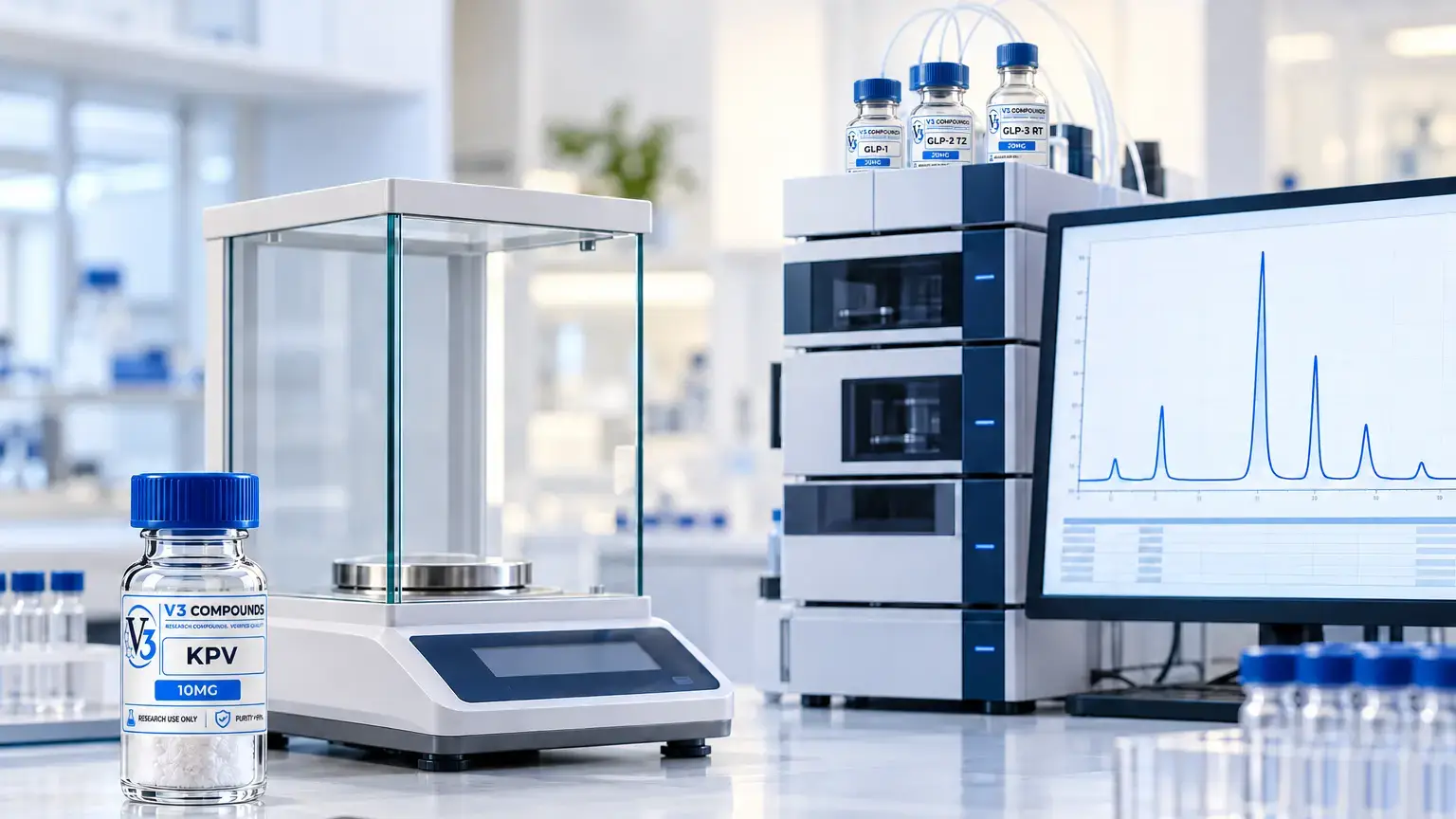
Find available documentation in the V3 COA Research Library. Product specifications and pack options are available in the research compound catalog, including the KPV 10mg research compound page shown conceptually in the article image.
Frequently Asked Questions
Does 99% HPLC purity mean a vial contains 99% of its labeled quantity?
No. A chromatographic area percentage and a labeled amount answer different questions. Determining content requires an appropriate quantitative method and a result reported with clear units.
Can HPLC area percentage establish the number of milligrams in a vial?
Not by itself. The report would need a separate quantitative measurement, suitable calibration and enough information to connect that result to the complete vial or prepared sample.
Where can I find a V3 Compounds certificate?
Search the Research Library by product or batch. If a matching certificate is not displayed, contact V3 Compounds with the product name and batch identifier.
Sources and Further Reading
- Agilent OpenLab: Area% and height%—the calculation and its detector-response assumptions.
- NIST: Reference material definitions—background on certified values, uncertainty and traceability; not a certification or endorsement of V3 products.
Prepared by V3 Compounds. Updated October 12, 2026. Educational reference for laboratory documentation.