
How to Match a Vial Batch Number to Its COA
The right COA is the one connected to the material you received. A familiar compound name or matching vial size is not enough to identify a production batch. Begin with the vial batch number printed on the label and establish how it relates to the laboratory report.
This practical workflow helps receiving laboratories organize documentation. It does not independently authenticate a report or verify the contents of a vial.
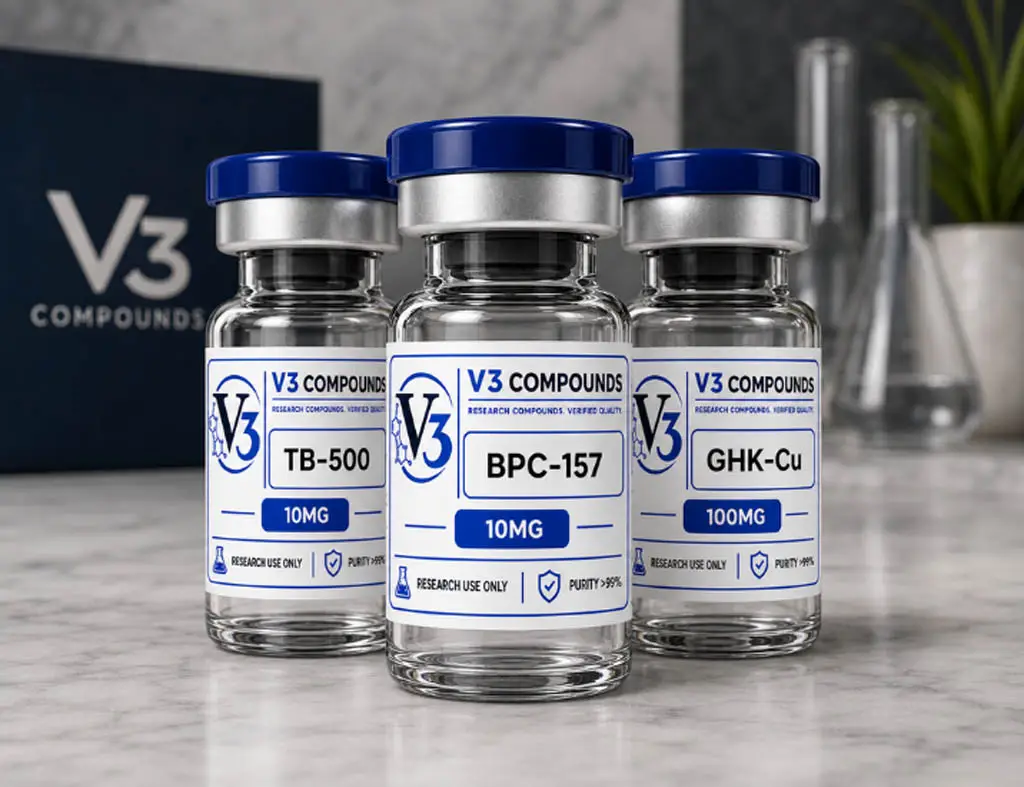
Vial Batch Number vs. Report Number
A batch or lot identifier links material to a production or handling record. A report number identifies an analytical document. A supplier may use the same code for both, or may use separate codes. Do not assume either convention without checking.
The word “batch” on a website card can be helpful for navigation, but the underlying report and the supplier’s records are where you should confirm the connection.
Step 1: Record the Label Exactly
Capture the product name, formulation, labeled quantity and batch or lot code. Preserve punctuation, leading zeros and letters. A clear photograph can help avoid transcription mistakes. Keep the order reference alongside these details in your internal receiving records.
For blends, record the stated components as well as the blend name. For multi-vial packs, check whether every vial bears the same identifier.
Step 2: Find the Candidate Certificate
Search the V3 COA Research Library by product name. Open the available document rather than relying only on the library summary. Look for the sample description, lot or batch field and report identifier.
A certificate associated with the same product is a candidate document until the batch connection is established. A different strength or formulation should prompt a question, not an assumption.
Step 3: Compare the Identifiers
Illustrative example: your vial might show lot “LAB-A17” while the report is numbered “REPORT-204.” Those different strings do not necessarily mean the report is wrong. They mean you need a documented link, such as a sample description naming LAB-A17 or a supplier record mapping that lot to REPORT-204.
Conversely, two nearly identical codes are not proof of a match. Check the full identifier and request clarification if there is an unexplained difference.
A product-specific example: GLP-3 RT 20mg
The GLP-3 RT 20mg documentation section identifies the linked report by its lot, accession and report date. Use those fields as a starting point, then compare them with the vial received. A matching product name and strength alone do not establish that the report applies to your shipment.
Step 4: Resolve Gaps Before Marking the Record Complete
- No vial code: ask the supplier how the received material is identified.
- Different report code: request the mapping between the lot and report.
- Missing pages: request the complete report and attachments.
- Multiple certificates: ask which document applies to the received batch.
- Unclear date: ask whether it is a test, report or production date.
Keep the unanswered question visible in your receiving record. Do not substitute another batch’s result because it is newer or has a higher purity percentage.
A Simple Receiving Record
Use fields for product, vial code, order reference, report number, test date, document location and any unresolved questions. Record when you checked the document. Keep an unaltered copy so later website changes do not erase the evidence you reviewed.
Two Different Meanings of Traceability
Tracking a vial to a report is a records connection. Metrological traceability concerns a measurement result’s relationship to a reference through a documented calibration chain, with uncertainty. NIST distinguishes these measurement requirements; merely matching a batch code does not establish them.
Read our full COA guide for interpreting methods and results. Contact V3 Compounds with the product name and vial code when documentation is missing.
Source and Scope
NIST: Metrological traceability supports the distinction between record matching and measurement traceability. The receiving checklist above is a practical documentation workflow, not a certification standard or NIST endorsement.
Prepared by V3 Compounds. Educational reference for laboratory documentation.